Monday, 14 November 2011

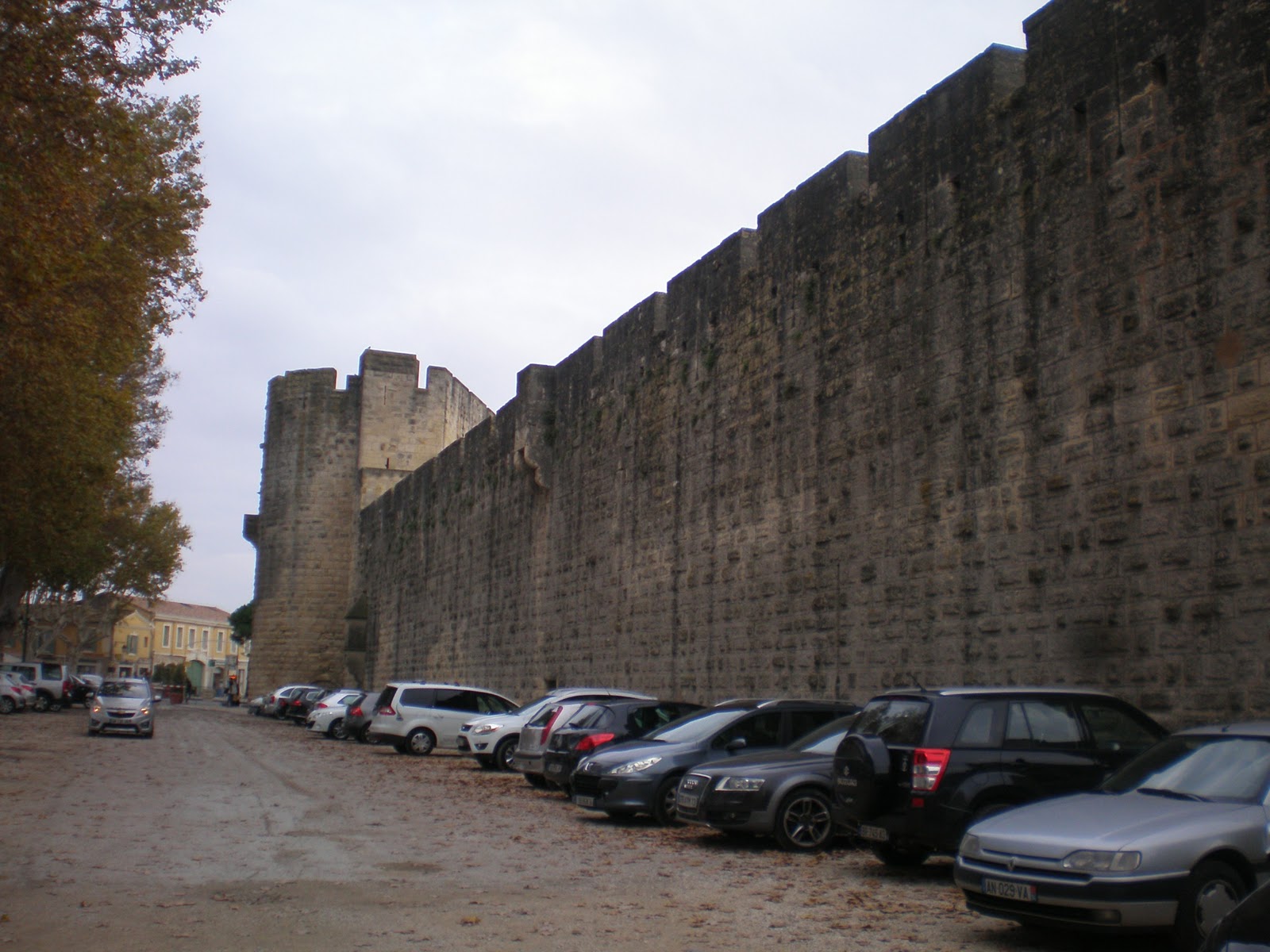
Just a bit more about Aigues-Mortes

Not only was this a trading port but also the point of departure for those going on a crusade. The town came about through king Louis IX, who also became known as Saint Louis, in the 13th century. His plan for the town was just about finished when he left in 1248 to go on the 7th crusade to Jerusalem. The walls were not actually finished till early 14th century. The town is enclosed on 4 sides by ramparts, herisse de tours et perce de portes.( with towers and gates).
This port was also the only way to get into France from the sea. Nearby there are mountains of salt, extracted from the sea. In earlier times, salt was used as a form of money and those who could produce it became very wealthy. Salt was even used as a form of revenue earning. Imagine paying your tax with salt!
Port de commerce et depart pour les croisades, ne de la volonte du roi Saint Louis, Aigues-Mortes fut l'unique acces maritime au royaume de France. Louis embarqua pour la septieme croisade en 1248. Le plan de la ville etait presque termine.
Other important things about this place is that it is not only one of the most spectacular medieval strongholds in all of Europe, but also one of the best preserved. Cette forteresse des sables (sand), intacte et preservee, est aujourd'hui l'une des fortifications medievales les plus spectaculaires et les mieux conservees d'Europe.


A fascinating place. I loved it.

Aigues-Mortes


I was completely captivated by this walled town. The ramparts and buildings really made be feel I had gone back in time. The astonishing thing is that people actually live here in these same houses as peoples from another time. You must excuse that I share so many photos of stone steps, doorways, little streets with arches, windows and doors, and bridges. These are my favourite places and I can't resist taking photos of them.
This was an important trading town in the Middle Ages as it was near the sea.

Sunday, 13 November 2011

Some more photos of those fabulous rocks


Le Lac Salagou


I thought I was back in Scotland. This lake has red rocks round it and the lake bottom is red too. It is because of the ferous oxide. The land and hills all have this red colour in the soil too. With the cloud overhead in a grey sky, I really felt back on my native soil. What stood out was the greenness of  the grass, coming up everywhere after the rain.
Then we visited the Cirque de Moureze, an amazing area of tall rocks/ fossils which we were told was caused by erosion. The whole area had been under water many years before our history. Another energetic hike up and around these boulders was well worth the effort. I would suggest you google image some of these places. Just fascinating.

St Guilhem


The village St Guilhem has quite changed since the rain. There's a torrent going through it now. We also were more energetic in the cooler weather and climbed to the top of the hill behind the village. La vue etait formidable!

Sunday, 6 November 2011

Stormy Weather


These photos were taken after the storm. The sky is clearing enough to see nearby Palavas Tower, but is still threatening further downpours. The field is flooded, "inondé", and those puddles are called "flaques d;eau." There are many of them. We were confronted with many closed roads, "car inondé", for they were flooded. The sky was "gris", grey, et apres les "eclairs", after the lightning flashes, "on a entendu le tonnerre", we heard the thunder. Not cold but very windy, expected up to 100km/hour. Le vent ici est violent.

Friday, 4 November 2011

Larzac


There was a national holiday on Tuesday 1st November to remember the dead. The shops were full of flowers and everyone had the day off to visit the cemeteries and leave their bouquets. Chrysanthemums were the favourite choice as they lasted longer. The cemeteries were indeed covered in flowers that day.
The language school arranged for us to visit a region known as Larzac, just north of Montpellier, about one and a half hours from here by motorway.
I was particularly interested in the walled village of La Couvertoirade, built about 1200 by the Knights Templar, as their base before fighting in the Crusades. In this small space you have a concentrated view of how people lived at that time, surrounded by ramparts and knights. There is a large lavogne, a stoned watering hole for the sheep, just outside the walls. This was a clever way of collecting rain water as it is a dry, barren area. You can see in the photos some of the stone steps up to the houses where people still live and have been living for over 800 years. Fascinating Place. The posters show some of the activities held here, similar to the jousting and other games of long ago.
Then I had another opportunity to see the famous Viaduc Maillau, this time from underneath. Well, I couldn't see all of it. Quite a lot was in the clowds. After all, it is higher than the Eiffel Tower at one point. I  am really amazed when I look at it, how it was possible to build such a bridge. Quite spectacular.
Our final stop was the village of Roquefort, where we were able to take a tour right into the heart of the mountain where real Roquefort cheese is made. It was cool and humide inside the caves and this temperature is carefully monitored to produce the most famous cheese in the world. There is quite a story behind its inception as far back as Roman times but I'll let you google that yourselves.
We returned to Montpellier tired but very pleased with our outing only to find that there had been a once in 50 years storm in Montpellier. There were floods everywhere, roads were blocked and traffic jams on all the roads into the centre. The river recorded 70 cm rise in one day. We eventually abandoned our bus and walked the last part. Tram lines were submerged and the underground tunnel was closed, causing mayhem. This stormy weather has lasted 4 days now. Hopefully we will have a dry day tomorrow. I have been returning home each day soaked. All part of the adventure. I have notice that no one lives on the ground floor in central Montpellier. Here's some weather report for you French students.
La pluie! Il y avait ici des orages violents qui ont provoque un episode pluvieux qui n'arrive que tous les 50 ans. On dit que la pluie ne dure longtemps. J'espere que c'est vrai. C'est aujourd'hui le quatrieme jour. Mardi on a eu les pieds dans l'eau, la circulation a ete arretee pendant des heures avec des embouteillages partout. Les rives de la riviere Lez ont ete interdites aux voitures car inondees. La hauteur du Lez a augmente de plus de 70 cm pendant une journee. Et ce n'est pas fini. Le vent continue a venir de la mer en rafales. Je suis arrivee chaque jour de l'ecole trempee jusqu'aux os. Mais c'est une aventure. J'adore les orages, surtout quand je suis a la maison!